
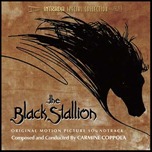
The Black Stallion (Carmine Coppola, 1978): Intrada’s 3-CD set of the score to The Black Stallion may simply be too much of a good thing, at least when attempting to listen to it all at once. The first two discs essentially contain everything that was written for the film: the score as heard in the movie, numerous unused cues, and various source cues. The 3rd disc contains the 35 minute LP program that was released with the film. The total of the 3 discs comes out to over 2 hours of music.
Fortunately, there is nothing that says that one has to listen to the music all at one time. Certainly the score is very good and it is certainly not a bad thing that all of it is available. For the most part, I’ve found that the album version is probably the best choice for listening straight through, while the other parts might be better suited to playing in parts or to occasionally include in broader “shuffle play” mixes.
While Carmine Coppola (father of Francis, who produced the film) is the primary credit composer, the film also contained contributions from composers Shirley Walker, Nyle Steiner, Kenneth Nash, George Marsh, and Dick Rosmini. The Intrada set includes appropriate credits for all the composers, thus making it possible to identify who wrote what parts.
Much of the score is very guitar-centered, with generally simple orchestration. The score includes a fairly distinctive primary theme melody (which opens and closes the original album presentation), which features a solo guitar backing a main melody played by the orchestra, particularly the strings. This theme is used throughout the score and generally establishes the overall tone of the presentation. Other parts of the score tend to have a bit of an ethnic flavor, with a number of different instruments in use. Some of the unused cues on the Intrada complete score discs are more fully orchestral than is generally heard on the cues used in the film.
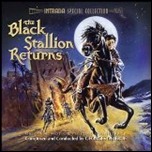
The Black Stallion Returns
Delerue doesn’t reuse the themes from the original film, but instead scores the film in his own distinctly melodic style. His main theme for the sequel does have some similarity, at least in spirit, to Carmine Coppola’s theme for the original film, but it is significantly more fully orchestral, with an emphasis on strings and woodwinds. The acoustic guitar that was fairly central to the first film’s score is not carried over to the sequel. I overall think that Delerue’s score is an easier and more satisfying listen than Coppola’s outside of the film. It tends to be more melodic and straightforward orchestral with a definite flare towards the adventurous.
A huge highlight on this soundtrack is the absolutely thrilling “Finale” cue, which runs for over 8 minutes in length and masterfully sums up all of the film’s themes on its way to an immensely satisfying conclusion. Due to the discs format of presenting the complete score followed by the original album, this finale is presented twice on the disc. It is good enough that I don’t really object to hearing it twice in one play through.
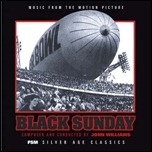
Black Sunday (John Williams, 1977): For many years, Black Sunday was arguably the most significant John Williams score that had never received a soundtrack release. In early 2010, Film Score Monthly finally corrected this by releasing a CD containing over an hour of Williams’ music from the film. The CD is part of their limited edition Silver Age Classics series, but they produced 10,000 copies which should keep it available for at least a little while.
This score was composed during possibly the most important phase of his career. The two other scores that he composed for films released the same year were Star Wars and Close Encounters of the Third Kind. His Black Sunday score does resemble his other scores from that time period, but it is quite a bit darker in tone as required by the disturbing subject matter of the film.
Building of tension is Williams’ prime role here and he is very effective at accomplishing that. For a good example, the cue “Nurse Dahlia/Kabakov’s Card/The Hypodermic” primarily features some low, fairly repetitive notes that build up a great deal of tension until the cue finally ends with a burst of shrieking strings reminiscent of Bernard Herrmann’s famous Psycho music. Another interesting cue is “The Test”, which features chimes, initially by themselves and then later joined by the orchestra’s string section, an effect that builds a notably tense and foreboding atmosphere.
Other cues do have a more melodic style, such as the fairly sad melody that Williams contributes for the cue “Moshevsky’s Dead” or the more active string and brass driven melody in “Preparations”. Williams also provides a melancholy, brass melody for the end titles, which the CD includes both in the film version and in a version without the underlying pop-style percussion.
The score also includes some very good chase and action music, particularly late in the score. It is in the action cues that the connections to his other scores of that time period are most evident. In particular, there is some noticeable similarities to some of the action cues from Close Encounters in this score.


 (Danny Elfman, 2003): While the film was definitely extremely quirky and off-beat, Big Fish is probably the least flamboyantly weird of Tim Burton’s films to date. The film’s story of an adult son recalling the tall tales that had been shared by his dying father is very character-driven drama, but in a format that still allows Burton to allow his very skewed view of the world to shine through. The variety of settings and circumstances of the recounted tales gave Danny Elfman a particularly rich set of opportunities and he delivers one of his more varied and complex scores.
 (Jerry Goldsmith, 1992): Throughout his career, Jerry Goldsmith all too frequently was hired as the composer for bad movies that failed at the box-office. Basic Instinct was a rare case where he scored a bad movie that ended up being a big hit. Obviously, there are probably a lot of people that disagree with my assessment of the film, but I also expect that most people will agree that Goldsmith’s score was among the film’s biggest strengths.

 (James Horner, 2001): This Oscar-winning drama was the fifth collaboration between composer James Horner and director Ron Howard. It was the most low-key and introspective of the films that the two have done together and Horner provided a suitably sensitive score, although one that will sound pretty familiar to fans of Horner’s work as it does use many of his favorite motifs.
 (Richard Sherman & Robert Sherman, 1971): Disney reteamed a number of key members of the creative team behind Mary Poppins for Bedknobs and Broomsticks, another musical that mixed live action and animation. While not as successful either creatively or financially as the earlier film, it is still a film with many charms, including another winning song score by the Sherman Brothers.

 (Alan Menken & Howard Ashman, 1991): Beauty and the Beast is my favorite of Disney’s animated films and on my short list of favorite movies in general. The film’s music is absolutely critical to its success. At the time, it was the closest that an animated film had come to duplicating the style of a modern Broadway musical and, thus, it was no big surprise when several years later an adaptation of the movie became Disney’s first Broadway show.

 (1989, Danny Elfman): Although Danny Elfman had already done a handful of film scores (including his first two projects with Tim Burton), his score for Burton’s 1989 Batman film really was the one that established him as an important voice in film scoring. The score was so successful that Elfman has frequently been the first choice for other super-hero movies, to a degree that sometimes has come perilously close to type-casting.
 (Danny Elfman, 1992): I’m well aware that my view is in the minority on this one, but I actually prefer both the film and score for Batman Returns to the more popular original. After the enormous success of the first film, both Tim Burton and Danny Elfman were given a considerable amount of free reign and the result was a much more quirky film and score.

 (Victor Young, 1956): When I wrote up my comments about the Trevor Jones score to the 2004 remake, I noted that I didn’t have a copy of Victor Young’s score in my collection. Some quick research found that a deluxe soundtrack release of that score from Hit Parade Records was pretty readily available and I ordered a copy from Amazon.com.
 (Alan Silvestri, 2010): It came as something of a pleasant surprise that Alan Silvestri was chosen to score the new film adaptation of the well-known 1980s action series, which was definitely a guilty pleasure for many of my generation. The film seemed like a more likely project for someone from the Hans Zimmer factory or for a more song-driven soundtrack.
  Bigbeaks Blog