
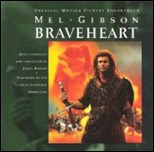
Braveheart
Horner has always been influenced quite a bit by Scottish and Irish regional music and the Scottish theme and setting of this film certainly gave him a major opportunity to directly exercise those influences. Thus, the score is pretty heavy on bagpipes, pan flute, and other instruments from that culture. Choral elements are also included and are used sparingly enough to be quite effective. That Horner has a tendency to sometimes mix Scottish and Irish influences in the score is somewhat of a minor quibble for most fans/viewers. The scores overall style is one that Horner has continued to revisit from time to time, most famously with his enormously popular Titanic score.
One element of the score’s popularity is Horner’s noble and evocative main theme, which is first introduced as a bagpipe melody during the “Main Title” cue and is presented in a variety of orchestrations throughout the rest of the score. Horner also provides a couple of effective, more romantic themes which are brought together very well in the cue “For the Love of a Princess”. The films’ several battle sequences are scored with a mix of fairly typical Horner action motifs along with some percussion-driven ethnic elements.
The soundtrack CD runs for a little over an hour and 17 minutes and features quite a few pretty lengthy cues. At that length, I think it very effectively covers the important parts of this score and may even be a bit long, considering that the score does repeat itself a fair amount. The ongoing popularity of the score resulted in the release of a second More Music From Braveheart
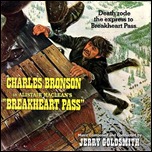
Breakheart Pass
The highlight of the score is definitely Goldsmith’s brassy and upbeat theme, which was pretty typical of his themes for the genre, but also extremely entertaining. The theme is fully developed in the terrific “Main Title” cue and also wraps the score up very well during the end credits suite. Goldsmith peppers the rest of the score with bits and pieces of the theme as well, although he doesn’t use it quite as regularly as he sometimes has with other main themes in his scores.
The score also has some good action music, with my favorite being the fast paced and exciting cue “On the Move – Runaway”, in which Goldsmith is able to musically very successfully evoke the image of a runaway train. The moving train motif is one that he returns to in several other cues as well, including “The Casket – Box Car Fight”. Overall, the score is a bit more driven by suspense cues, although periodically punctuated by some bursts of fairly exciting action.
One somewhat surprising aspect to this score is that Goldsmith fairly rarely uses common western conventions (the harmonica is almost entirely absent), instead giving the score a somewhat more modern sound, even using electronics occasionally. The main theme is generally pretty brassy and the action sequences are dominated by brass and strings. Some of the score’s quieter moments include some sensitive acoustic guitar and woodwind music as well.
La La Land Records released a limited edition (3,000 copies) CD containing 45 minutes of the score. The CD is sold out, but copies can generally be found in the $25-$30 range. This is a good score and definitely worth seeking out for Goldsmith’s fans, particularly those that especially enjoy his western themes.
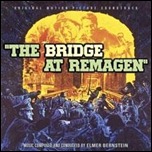
The Bridge at Remagen
The score opens with a very impressive “Main Title” cue featuring an exciting, military-style march with lots of brass and percussion. It is the type of theme that really grabs your attention. While I haven’t seen the film, I would imagine this theme was a very effective way to get the audience pumped up and attentive.
Bernstein does occasionally return to the main theme during the rest of the score, but other parts of the score are quieter and more subtle in nature. Often times, the score shifts to fairly intimate, string and/or piano focused melodies, often intermixed with periodic shifts to brass and percussion that signal more action oriented segments. Particularly good examples of this mix are the cues “Defenses” and “Confrontation/More Madness”. The combination is quite effective and very enjoyable.

 (John Powell, 2008): Disney’s 2008 CGI animated feature was not a musical, thus the soundtrack album primarily features the orchestral score by composer John Powell, who has generally done some of his best work in animated features (including Shrek, the Ice Age sequels, Kung Fu Panda, and How to Train Your Dragon). This was his first score for Disney and it is well suited to the film.

 (John Williams and Various artists, 1989): This film featured John Williams first of the three scores (preceding JFK and Nixon) that he composed for director Oliver Stone. Those scores were among the darkest and most somber that Williams composed. This means that they weren’t among the most accessible to listen to separately from the films, but the scores were exceptionally effective within the films. The Born on the Fourth of July score isn’t one that I return to very often, but it is a very impressive, serious composition that should be a part of any serious film music collection.
 (Georges Delerue, 1983): Not too long after Intrada put out their CD release of The Black Stallion, they also put out a disc of Georges Delerue’s score to the film’s sequel. While this score only required a single CD release, it still contains the complete score as heard in the movie as well as the original 1983 album presentation for a total running time of around an hour and 17 minutes.


 (Danny Elfman, 2003): While the film was definitely extremely quirky and off-beat, Big Fish is probably the least flamboyantly weird of Tim Burton’s films to date. The film’s story of an adult son recalling the tall tales that had been shared by his dying father is very character-driven drama, but in a format that still allows Burton to allow his very skewed view of the world to shine through. The variety of settings and circumstances of the recounted tales gave Danny Elfman a particularly rich set of opportunities and he delivers one of his more varied and complex scores.
 (Jerry Goldsmith, 1992): Throughout his career, Jerry Goldsmith all too frequently was hired as the composer for bad movies that failed at the box-office. Basic Instinct was a rare case where he scored a bad movie that ended up being a big hit. Obviously, there are probably a lot of people that disagree with my assessment of the film, but I also expect that most people will agree that Goldsmith’s score was among the film’s biggest strengths.

 (James Horner, 2001): This Oscar-winning drama was the fifth collaboration between composer James Horner and director Ron Howard. It was the most low-key and introspective of the films that the two have done together and Horner provided a suitably sensitive score, although one that will sound pretty familiar to fans of Horner’s work as it does use many of his favorite motifs.
 (Richard Sherman & Robert Sherman, 1971): Disney reteamed a number of key members of the creative team behind Mary Poppins for Bedknobs and Broomsticks, another musical that mixed live action and animation. While not as successful either creatively or financially as the earlier film, it is still a film with many charms, including another winning song score by the Sherman Brothers.

 (Alan Menken & Howard Ashman, 1991): Beauty and the Beast is my favorite of Disney’s animated films and on my short list of favorite movies in general. The film’s music is absolutely critical to its success. At the time, it was the closest that an animated film had come to duplicating the style of a modern Broadway musical and, thus, it was no big surprise when several years later an adaptation of the movie became Disney’s first Broadway show.

 (1989, Danny Elfman): Although Danny Elfman had already done a handful of film scores (including his first two projects with Tim Burton), his score for Burton’s 1989 Batman film really was the one that established him as an important voice in film scoring. The score was so successful that Elfman has frequently been the first choice for other super-hero movies, to a degree that sometimes has come perilously close to type-casting.
 (Danny Elfman, 1992): I’m well aware that my view is in the minority on this one, but I actually prefer both the film and score for Batman Returns to the more popular original. After the enormous success of the first film, both Tim Burton and Danny Elfman were given a considerable amount of free reign and the result was a much more quirky film and score.

 (Victor Young, 1956): When I wrote up my comments about the Trevor Jones score to the 2004 remake, I noted that I didn’t have a copy of Victor Young’s score in my collection. Some quick research found that a deluxe soundtrack release of that score from Hit Parade Records was pretty readily available and I ordered a copy from Amazon.com.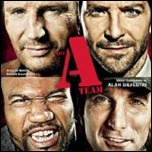
 (Alan Silvestri, 2010): It came as something of a pleasant surprise that Alan Silvestri was chosen to score the new film adaptation of the well-known 1980s action series, which was definitely a guilty pleasure for many of my generation. The film seemed like a more likely project for someone from the Hans Zimmer factory or for a more song-driven soundtrack.
 (Hans Zimmer, 1991): I’m pretty sure that Backdraft was the first film in which I really noticed a Hans Zimmer score enough to purchase the soundtrack album. Of course, Zimmer has become one of the most successful working composers in subsequent years, but his distinctive style was something of a fresh discovery back in 1991.


 Bigbeaks Blog